Metal-Organic Frameworks :: The True Extension Charm of Chemistry
Introduction
Evolution of MOF
- 0-Dimension (Molecules): At the most basic level, we start with individual metal ions (or clusters) and organic linkers. These are discrete, separate units with no repeating structure in any direction.
- 1-Dimension (Polymer Monolayers): When these 0-D building blocks are linked in a single repeating direction, they form linear chains, where the linkers connect metal centers in a one-dimensional array.
- 2-Dimension (Layers/Sheets): By extending the connections into two directions, the material forms flat, lattice-like sheets. These 2-D layers are often stacked on top of each other, held together by weaker intermolecular forces.
- 3-Dimension (MOF Structures): The final stage is a fully extended, three-dimensional crystalline framework. Here, the metal nodes and organic linkers form a robust, porous cubic lattice. This 3-D structure is what gives MOFs their legendary surface area and the "inexhaustible" storage capacity.

Sneak-Peek into MOF
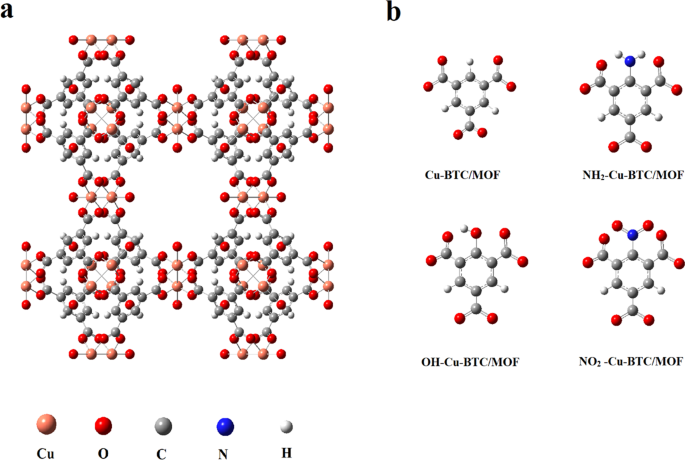
When donors such as bipyridine or benzene-1,3,5-tricarboxylate are introduced, they act like links in between multiple unit cells in the metal, which acts like a node where the linkers join together. Their ability to bind in multiple directions allows the formation of extended frameworks, creating empty spaces within the structure known as voids. These structures can have extremely high surface areas, allowing them to store significant amounts of gas within a very small volume, which is why these materials were specifically designed.
Imagine a cube with particles at each vertex and additional particles at the centres of its faces. As more particles are packed into this arrangement, small gaps remain between them due to the geometry of packing. These gaps are the voids within the structure. These voids are what allow gases to be stored in the way we want them to. The diagram below represents exactly what I have said.
In metallic systems such as copper, atoms are held together by delocalised electrons, which move freely across the structure. This type of bonding, combined with efficient packing, contributes to the rigidity and stability of the lattice. Now introduce these linkers into the crystal lattice of the bulk metal, under specific reaction conditions.
(Many people will feel tempted to think that this is how MOFs are formed but this is, of course, only an analogy to help visualise the structure. In reality, MOFs are synthesised from scratch through processes such as solvothermal synthesis, where metal salts and organic linkers are dissolved in a suitable solvent under elevated temperature and pressure to promote controlled crystallisation of the framework.
Additionally, compounds known as surfactants can be used to influence the size and shape of the resulting MOF crystals.)
What we obtain is somewhat similar to a molecular construction set where rigid parts are assembled into a flexible, functional container.

- The Straight Rods (The Linkers): In a MOF, these represent the organic linkers. On their own, they are just individual pieces with no capacity to hold anything. But in the whole framework, they define the stability and storage capacity of the structure.
- The Bending and Connection (The Nodes): When these rods are connected at specific points (the metal nodes), they can be angled or "bent" relative to one another to create a closed shape, like a triangle or a square. This "bending" of the assembly creates a vessel for gaseous storage.
- Containing Items: Just as a birdcage made of rods can hold a bird, these molecular "cages" have internal voids. Small molecules (like hydrogen or CO2) can enter through the gaps and become trapped or "stored" within the empty space of the vessel.
- Extending to 3D: Each of these individual cages connect to form a massive, 3D crystalline lattice. This turns the "vessel" into a vast, porous sponge where nearly every room i.e. void in the structure can potentially be used to hold different items simultaneously.
MOF Under Pressure
Under sufficient pressure, the crystal structure itself may shift from one state to another to remain stable. This occurs through a phase transition, where the material changes from one structural form to another depending on the energy of the system, influenced by both temperature and pressure.

Applications of these vessels
What makes these structures remarkable is their ability to combine stability, adaptability, and controlled empty space within a single system. This allows them to store molecules efficiently and respond to changes in their environment without collapsing.
Because of these properties, metal-organic frameworks are being explored for applications such as hydrogen storage, gas separation, and controlled molecular transport. Hydrogen storage, in particular, is one of the most explored fields due to the scarcity of common energy sources such as coal, natural gas. Hydrogen, on the other hand, has been found out to be a clean, high-energy fuel since its reaction with oxygen releases huge amounts of energy while the only by-product that is formed is just water. We have seen its use as a fuel, in the form of hydrogen-oxygen fuel cells during the Space Shuttle program between 1981-2011. However, there are a few problems with it. It is highly inflammable and very hard to store. Actually, the reason we do not face these issues with other gases is because their physical properties are such that they can very easily be made into a liquid under normal temperature. All that needs to be done is to increase the pressure of the container in which it is stored.
Metal-organic frameworks, however, approach this problem differently. Instead of forcing gas molecules into a small volume through pressure, they allow gases to adsorb onto their internal surfaces, which are extremely large, often exceeding 5000 m² per gram, which is roughly equivalent to several football fields packed into a single gram of material, allowing MOFs to store significant amounts of gases even at much lower pressures, especially when the interactions between the gas and the MOF are very strong. However, this introduces an important constraint. Adsorption is highly sensitive to both temperature and interaction strength. While many MOFs show impressive hydrogen uptake under cryogenic conditions, their performance often drops significantly at room temperature since the gas molecules possess too much thermal energy to be able to significantly interact with the relatively fixed lattice of the solid. This highlights one of the central challenges in translating these materials into practical energy systems, where research is currently ongoing to overcome the issue of temperature-dependent storage.
For instance, some MOFs have been shown to store hydrogen in the range of 5–10 wt% (the ratio of weight of gas to weight of MOF) under optimized conditions, making them competitive with existing storage technologies. In addition to this, their highly modifiable pore size, through varying the amount of the organic linker molecule or by changing it completely, allows them to selectively adsorb certain gases over others, which is particularly useful in applications such as carbon dioxide capture and gas separation.
Their use in reaction catalysis is also being currently explored. As we have seen before, a small amount of this material is able to store large volumes in their bulk and also on the surface. (For those who may be interested in the results of some of these applications, do read this paper from the RSC journal). This represents a high surface volume and, hence, a high adsorption capacity which, when paired with adjustable pore size, enables the formation of catalysts which can be reused to form products in high yield, while also being easily modifiable to direct the formation of new types of products (this falls under a separate class of reactions which I will talk about in a later blog).
One thing is for sure:- In many ways, they represent a bridge between structure and function — where careful design at the molecular level leads to powerful real-world applications. This is truly a case of 'what if physical and organic chemistry had a baby and created a magical spell of its own'.
ADIOS!!👋👋


Comments
Post a Comment